

Few things make dog owners more anxious than seeing their dog suddenly develop diarrhea. One minute your dog is happily eating dinner, and the next they’re asking to go outside every hour—or leaving loose stools around the house. Once you’ve ruled out an emergency, one of the first recommendations you’ll often hear is to feed boiled chicken and rice.
But that advice immediately raises another question: How much should you actually feed?
Some owners worry they’re feeding too little and that their dog isn’t getting enough nutrition. Others make the opposite mistake by filling the bowl with a large serving, only to find that the diarrhea or vomiting returns a few hours later. Even though chicken and rice is considered a gentle recovery diet, portion size matters just as much as the ingredients themselves.
The right amount depends on several factors, including your dog’s weight, age, appetite, activity level, and how severe their digestive upset is. A small Chihuahua recovering from one episode of loose stool needs a very different feeding plan than a Labrador that’s been dealing with diarrhea for two days.
In this guide, you’ll learn exactly how much chicken and rice to feed a dog with diarrhea, including easy-to-follow weight charts, meal frequency recommendations, the ideal chicken-to-rice ratio, common feeding mistakes to avoid, and signs that tell you it’s time to stop home care and call your veterinarian.
If you’re looking for a complete overview of when and why veterinarians recommend this type of recovery diet, you may also want to read our guide on a bland diet for dogs. Here, we’ll focus specifically on getting the portion sizes right, so you can help your dog recover without accidentally overfeeding or slowing the healing process.
How Much Chicken and Rice Should You Feed a Dog With Diarrhea?
If you’re looking for a quick answer, most healthy adult dogs should be fed small, frequent meals of boiled chicken and white rice based on their body weight, rather than one or two large meals. While there isn’t a single portion that works for every dog, a good starting point is to divide your dog’s normal daily food amount into 3 to 5 smaller meals using a mixture of two parts cooked white rice to one part boiled, skinless chicken breast.
However, the exact amount your dog needs depends on several important factors, including their weight, appetite, activity level, and the severity of their diarrhea. A 10-pound Chihuahua recovering from a mild stomach upset has very different nutritional needs than a 70-pound Labrador with several episodes of diarrhea.
🐶 Quick Answer: Feed a bland mixture of 2 parts cooked white rice and 1 part boiled skinless chicken, divided into 3–5 small meals per day. Adjust the total amount according to your dog’s body weight, appetite, and recovery progress.
The goal isn’t to get your dog to eat as much as possible—it’s to provide enough nutrition to support healing without overwhelming an already irritated digestive system. Offering a large bowl of food too soon is one of the most common reasons dogs vomit again or develop another episode of loose stool after they initially seem to improve.
⚖️ Your Dog’s Weight Matters Most
Body weight is the biggest factor when deciding how much chicken and rice to feed.
For example:
- 🐕 A 5-pound dog may only tolerate a few tablespoons per meal.
- 🐕🦺 A 25-pound dog can usually eat several small half-cup servings throughout the day.
- 🦮 A 70-pound dog will naturally require much larger portions to meet its energy needs.
Rather than copying someone else’s feeding schedule, always base portions on your own dog’s size.
In the next section, you’ll find a detailed weight-based feeding chart that makes portioning much easier.
🍽️ Appetite Is an Important Guide
Not every dog wants to eat immediately after diarrhea.
Some dogs begin asking for food within a few hours, while others have a reduced appetite for a day or two. That’s perfectly normal.
If your dog seems interested in eating:
- ✅ Start with a small portion.
- ✅ Wait a couple of hours to make sure they keep it down.
- ✅ Gradually offer another small meal if they’re comfortable.
Avoid encouraging your dog to finish a large serving simply because they seem hungry. A recovering stomach often tolerates small meals much better than large ones.
On the other hand, if your dog completely refuses food for more than 24 hours, or much sooner if they’re a puppy or toy breed, it’s time to contact your veterinarian.
🤢 The Severity of Diarrhea Also Makes a Difference
The amount of chicken and rice you feed should also reflect how severe your dog’s digestive upset is.
For example:
Mild Diarrhea
- One or two loose stools
- Bright and alert
- Drinking water normally
- Eating willingly
➡️ These dogs can often begin with small, frequent meals of chicken and rice while being monitored closely at home.
Moderate Digestive Upset
- Frequent loose stools
- Mild decrease in appetite
- Slightly lower energy
➡️ Smaller portions offered more often may be easier for the digestive system to handle.
Severe Symptoms
- Bloody diarrhea
- Repeated vomiting
- Severe lethargy
- Signs of dehydration
- Refusing food and water
➡️ A homemade chicken and rice diet is not enough. These dogs should be examined by a veterinarian as soon as possible instead of continuing home treatment.
💡 Start Small and Increase Only if Your Dog Is Improving
One of the best approaches is to let your dog’s recovery guide your feeding.
If your dog:
- 🐾 Keeps meals down without vomiting
- 🐾 Starts producing firmer stools
- 🐾 Drinks water normally
- 🐾 Becomes more energetic
You can gradually increase meal size while continuing to divide the total amount into several smaller feedings.
If symptoms worsen after eating, don’t simply feed more chicken and rice. Instead, reassess your dog’s condition and contact your veterinarian if recovery isn’t progressing as expected.
Key Takeaway: The “right” amount of chicken and rice isn’t determined by a single number—it’s determined by your dog’s size, appetite, and how they’re responding to treatment. Feeding smaller portions more frequently and adjusting based on your dog’s recovery is far more effective than offering large meals all at once.
Why Portion Size Matters
When your dog has diarrhea, what you feed is important—but how much you feed can make just as much difference. Even if you’re using the right ingredients, feeding the wrong portion size can slow recovery or even make digestive symptoms worse.
Many dog owners assume that because chicken and rice are gentle on the stomach, they can let their dog eat as much as they want. Others become so worried about upsetting the stomach that they feed only a few bites for several days. Unfortunately, both approaches can create problems.
The goal is to provide enough food to support recovery without overwhelming an already irritated digestive system.
🍽️ Overfeeding Can Make Diarrhea Worse
One of the most common mistakes is offering a full-sized meal as soon as a dog seems hungry.
It’s easy to understand why. After diarrhea or vomiting, many dogs act as if they haven’t eaten in days. But a returning appetite doesn’t necessarily mean the digestive system is fully recovered.
A large meal can:
- Increase the workload on the stomach and intestines
- Trigger another episode of vomiting
- Cause loose stools to return
- Delay the healing process
- Make it difficult to tell whether your dog is actually improving
This is why veterinarians usually recommend small, frequent meals during the first couple of days instead of one or two large servings.
💡 A hungry dog doesn’t always need a bigger meal—they often need smaller meals more often.
🥄 Underfeeding Isn’t Helpful Either
On the other hand, feeding too little isn’t the answer.
While it’s normal for dogs to eat slightly less during digestive recovery, they still need enough calories and protein to support:
- Normal body functions
- Energy levels
- Muscle maintenance
- Tissue repair
- Immune system function
Dogs recovering from diarrhea are already losing fluids and nutrients. If they don’t receive enough food for several days, they may become weaker and take longer to regain their strength.
The key is finding a balance between gentle feeding and adequate nutrition.
🩺 Smaller Meals Are Easier to Digest
An irritated digestive system works much harder than a healthy one.
When large amounts of food enter the stomach all at once, digestion becomes more demanding. Smaller portions, however, are generally processed more comfortably.
Benefits of smaller meals include:
- ✅ Less stress on the stomach
- ✅ Better nutrient absorption
- ✅ Reduced risk of vomiting
- ✅ More consistent digestion
- ✅ Gradual improvement in stool quality
That’s why many veterinarians recommend dividing your dog’s daily food into three to five meals instead of following their normal feeding schedule during recovery.
🌿 Proper Portions Support Faster Healing
Healing isn’t just about stopping diarrhea.
The digestive tract also needs time to repair the irritated lining of the stomach and intestines, restore normal water absorption, and return to healthy digestion.
Feeding appropriate portions helps by:
- Giving the digestive system manageable amounts of food to process
- Allowing nutrients to be absorbed more efficiently
- Reducing unnecessary irritation
- Supporting a gradual return to normal bowel movements
While every dog heals at a different pace, proper portion control creates the best conditions for recovery.
⚠️ Watch Your Dog—Not Just the Food Bowl
Rather than focusing only on how much food is left in the bowl, pay attention to how your dog responds after each meal.
Good signs include:
- 🐶 Eating willingly without rushing
- 💩 Stool becoming firmer over time
- 💧 Drinking water normally
- 😊 Improving energy levels
- 🤢 No vomiting after meals
If your dog consistently handles small meals well, you can gradually increase portions as recovery progresses. However, if each meal seems to trigger more diarrhea or vomiting, stop increasing the amount and contact your veterinarian.
💡 Think Beyond the Ingredients
Chicken and rice can be an excellent short-term recovery diet, but portion size is what determines whether that diet helps or hinders your dog’s recovery.
Feeding measured, appropriately sized meals is often more beneficial than simply offering unlimited bland food. Combined with plenty of fresh water and careful monitoring, proper portion control gives your dog’s digestive system the best opportunity to heal.
If you’d like to learn more about when, why, and how veterinarians use this type of recovery diet, read our complete guide to bland diet for dogs. It explains the role of bland diets in digestive recovery and when they’re appropriate to use.
The Best Chicken and Rice Ratio for Dogs
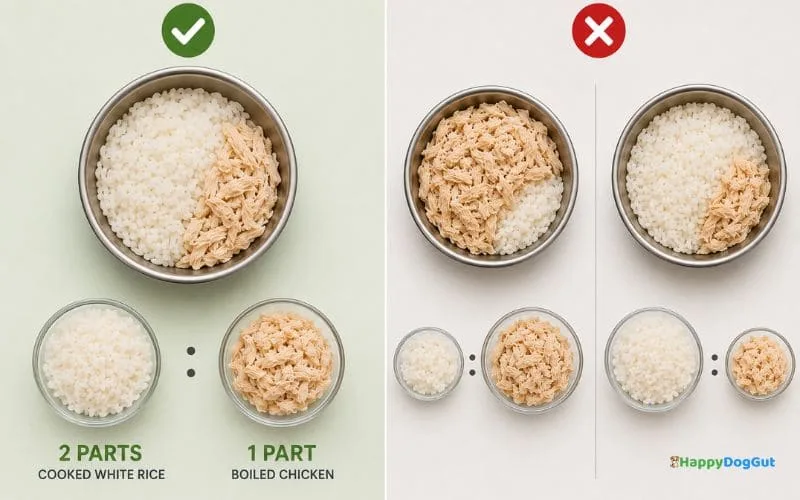
When preparing chicken and rice for a dog with diarrhea, getting the ratio right is just as important as choosing the right ingredients. Too much chicken can make the meal richer than intended, while too much rice may not provide enough protein to support recovery.
For most healthy adult dogs, veterinarians commonly recommend a 2:1 ratio—two parts cooked white rice to one part boiled, skinless chicken breast. This balance gives your dog easily digestible carbohydrates for energy while providing enough lean protein to help maintain muscle and support healing.
Keep in mind that this ratio is intended for short-term digestive recovery, not as a complete, balanced diet for everyday feeding.
🍚 Why Is White Rice the Larger Portion?
White rice makes up most of the meal because it’s one of the easiest carbohydrates for many dogs to digest.
During diarrhea, the digestive tract is often irritated and temporarily less efficient at processing food. White rice is low in fiber, gentle on the stomach, and provides a readily available source of energy without putting excessive strain on the intestines.
Benefits of white rice include:
- ✅ Easy to digest
- ✅ Gentle on an irritated stomach
- ✅ Provides quick energy
- ✅ Helps create firmer stools in many dogs
- ✅ Low in fat, making it suitable for short-term recovery
Brown rice, while nutritious for healthy dogs, contains more fiber and can be harder to digest during an active bout of diarrhea. That’s why plain cooked white rice is usually the preferred choice for a bland diet.
🍗 Why Use Boiled Chicken Breast?
Chicken is included because it’s a lean, highly digestible source of protein.
When dogs experience diarrhea, they still need protein to maintain muscle and support normal body functions. However, fatty meats can stimulate the digestive system and sometimes make symptoms worse.
Boiled, skinless chicken breast is ideal because it:
- ✅ Is naturally low in fat
- ✅ Is easy to digest
- ✅ Provides high-quality protein
- ✅ Is gentle on a recovering stomach
- ✅ Has a mild flavor that many dogs will eat even when their appetite is reduced
To keep the meal as gentle as possible:
- Remove the skin.
- Trim visible fat.
- Boil the chicken in plain water.
- Avoid seasoning, butter, oils, garlic, onions, or broth containing salt.
🦃 When Can Turkey Be a Good Alternative?
If your dog doesn’t tolerate chicken well—or has a known chicken allergy—plain boiled turkey breast can be an excellent substitute.
Turkey offers many of the same benefits as chicken:
- Lean protein
- Easy digestion
- Low fat (when skin is removed)
- Mild flavor
- Good nutritional value
Choose skinless turkey breast, cook it thoroughly in plain water, and avoid processed turkey products such as deli meat, smoked turkey, or seasoned ground turkey, which often contain sodium and spices that aren’t appropriate during digestive recovery.
If your dog has previously been diagnosed with a food allergy or food intolerance, your veterinarian may recommend a different protein source altogether.
📊 Chicken vs. Rice: What Each Ingredient Contributes
| Ingredient | Why It’s Included | Benefits During Recovery |
|---|---|---|
| Boiled White Rice | Easily digestible carbohydrate | Provides energy, is gentle on the stomach, and may help improve stool consistency |
| Boiled Skinless Chicken Breast | Lean protein | Supports muscle maintenance, tissue repair, and recovery without adding excess fat |
| Boiled Turkey Breast (Alternative) | Lean protein substitute | A good option for dogs that don’t tolerate chicken or need a different protein source |
💡 Stick With the Ratio Until Recovery Is Complete
It can be tempting to add extra chicken because dogs usually love the taste, but more protein isn’t always better during digestive recovery.
Keeping the meal close to the recommended 2:1 rice-to-chicken ratio helps maintain a balance that’s easy on the digestive system while still providing the nutrients your dog needs over the short term.
Once your dog’s stools are firm, appetite has returned, and they’re acting like themselves again, you can begin gradually transitioning back to their regular, complete and balanced dog food rather than continuing a homemade chicken and rice diet indefinitely.
Chicken and Rice Feeding Chart by Dog Weight
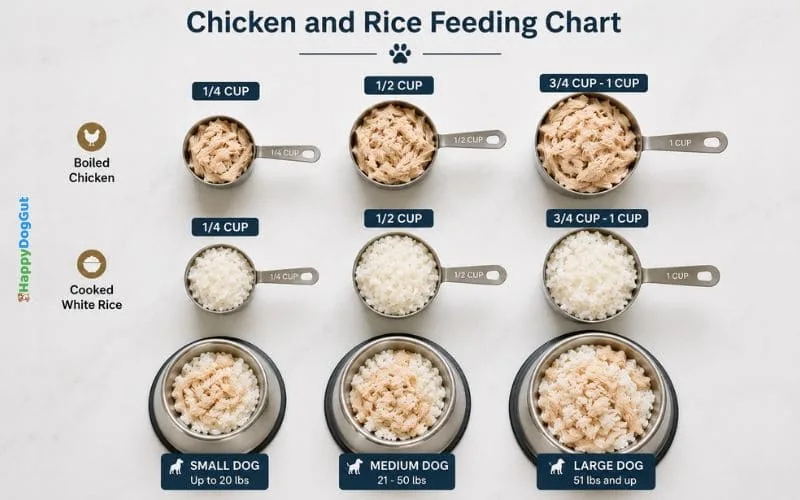
One of the most common questions dog owners ask is, “Exactly how much chicken and rice should I feed my dog?” The answer isn’t one-size-fits-all. Your dog’s body weight is the best starting point for determining portion sizes, but you’ll also need to consider their appetite, activity level, and how they’re responding to the bland diet.
The chart below provides general daily feeding guidelines for healthy adult dogs recovering from mild diarrhea. These amounts are meant to be divided into 3–5 small meals throughout the day rather than offered all at once.
💡 Tip: Start at the lower end of the recommended amount if your dog has recently vomited or still has frequent diarrhea. You can gradually increase portions as their appetite and stool improve.
🍗 Chicken and Rice Feeding Chart
| Dog’s Weight | Total Daily Amount | Meals Per Day | Portion Per Meal |
|---|---|---|---|
| 5 lbs (2.3 kg) | ½–¾ cup | 4 meals | 2–3 tbsp |
| 10 lbs (4.5 kg) | ¾–1 cup | 4 meals | ¼ cup |
| 15 lbs (6.8 kg) | 1–1¼ cups | 4 meals | ¼–⅓ cup |
| 20 lbs (9 kg) | 1¼–1½ cups | 4 meals | ⅓–⅜ cup |
| 30 lbs (13.6 kg) | 1¾–2¼ cups | 4 meals | ½ cup |
| 40 lbs (18 kg) | 2¼–2¾ cups | 4 meals | ½–⅔ cup |
| 50 lbs (22.7 kg) | 2¾–3¼ cups | 4 meals | ⅔–¾ cup |
| 60 lbs (27 kg) | 3¼–3¾ cups | 4 meals | ¾–1 cup |
| 80 lbs (36 kg) | 4–5 cups | 4–5 meals | ¾–1 cup |
| 100 lbs (45 kg) | 5–6 cups | 4–5 meals | 1–1¼ cups |
Feeding the correct amount is only part of recovery. If your dog still has loose stool after chicken and rice, the cause may be something other than portion size, such as stress, food sensitivity, or an underlying digestive issue.
Note: These are general guidelines for temporary feeding during recovery. Individual calorie needs vary based on age, breed, body condition, and activity level. Dogs with chronic medical conditions should follow their veterinarian’s feeding recommendations.
🐾 Practical Feeding Examples
Sometimes it’s easier to picture what these portions look like in real life.
Example 1: Small Dog (10 lbs)
A 10-pound Shih Tzu has mild diarrhea after eating table scraps but is still bright, alert, and drinking water.
A good starting plan would be:
- Daily total: 1 cup of chicken and rice
- Divide into 4 meals
- Feed ¼ cup every 4–5 hours
This keeps meals small enough to avoid overwhelming the stomach while still providing enough energy throughout the day.
Example 2: Medium Dog (30 lbs)
A 30-pound Beagle develops loose stools after a sudden diet change.
A typical recovery plan might be:
- Daily total: 2 cups
- Divide into 4 meals
- Feed ½ cup per meal
If stools begin to firm up after the first day, portions can be increased gradually while maintaining the same meal frequency.
Example 3: Large Dog (70–80 lbs)
A 75-pound Labrador Retriever has mild diarrhea but is eating and drinking normally.
A reasonable starting point would be:
- Daily total: 4½ cups
- Divide into 5 meals
- Feed about ¾ to 1 cup per meal
Large dogs may seem capable of handling bigger meals, but smaller, evenly spaced portions are usually easier on the digestive system during recovery.
🍽️ Adjust Portions Based on Recovery
The feeding chart is a starting guide—not a strict rulebook.
Continue watching your dog after every meal.
If your dog:
- ✅ Finishes meals comfortably
- ✅ Keeps food down
- ✅ Drinks water normally
- ✅ Produces firmer stools
- ✅ Shows more energy
You can continue following the chart and gradually increase portions if needed.
However, if your dog:
- ❌ Vomits after eating
- ❌ Develops worsening diarrhea
- ❌ Refuses food
- ❌ Appears uncomfortable after meals
Reduce the meal size and contact your veterinarian if symptoms persist.
💡 Portion Size Should Support Recovery—Not Rush It
Many owners believe feeding larger portions will help their dog recover faster, but digestive healing doesn’t work that way.
A recovering stomach and intestines generally handle small, measured meals much better than oversized servings. Feeding the right amount at the right frequency gives your dog’s digestive system the best chance to absorb nutrients while minimizing irritation.
🐶 Key Takeaway: Use your dog’s weight as the starting point, divide the total daily amount into 3–5 small meals, and adjust portions based on how your dog is eating, drinking, and recovering—not simply how hungry they seem.
Meal Frequency During Recovery

When a dog has diarrhea, how often you feed can be just as important as how much you feed. Even if you’re serving the correct amount of chicken and rice, giving it all in one or two large meals can put unnecessary strain on a recovering digestive system.
That’s why veterinarians often recommend dividing your dog’s daily food into several small meals instead of following their normal feeding schedule. Smaller meals are generally easier to digest, help reduce the risk of vomiting, and allow the intestines to absorb nutrients more efficiently.
Think of it this way: your dog’s stomach is recovering from irritation. Offering small portions throughout the day is much gentler than asking it to process one large meal all at once.
📊 Recommended Meal Frequency
| Recovery Stage | Meals Per Day | Best For | Goal |
|---|---|---|---|
| Mild Diarrhea | 3 meals | Dogs that are improving and have a good appetite | Maintain nutrition while gradually returning to normal feeding. |
| Moderate Diarrhea | 4 meals | Most healthy adult dogs during the first 1–2 days | Reduce digestive workload and support healing. |
| Sensitive Stomach or Recent Vomiting | 5 small meals | Dogs with reduced appetite or easily upset stomachs | Minimize nausea and make digestion as gentle as possible. |
💡 General rule: Smaller meals eaten more frequently are usually better tolerated than fewer large meals.
🥣 Three Meals Per Day
Once your dog’s diarrhea is improving and they’re eating comfortably, three evenly spaced meals are often enough.
A simple schedule could look like this:
- 🌅 Morning
- 🌞 Afternoon
- 🌙 Evening
This works well for dogs that:
- Have a normal appetite
- Haven’t vomited recently
- Are producing firmer stools
- Are becoming more active again
Many dogs can continue this schedule until they’re ready to transition back to their regular food.
🥄 Four Meals Per Day
For most dogs recovering from mild to moderate diarrhea, four smaller meals provide an excellent balance between nutrition and digestive comfort.
Instead of giving one large breakfast and dinner, spread the food throughout the day.
Example schedule:
- 7:00 AM – Breakfast
- 11:30 AM – Midday meal
- 4:00 PM – Afternoon meal
- 8:00 PM – Evening meal
This approach helps prevent the stomach from becoming overly full and often results in fewer digestive flare-ups.
🍗 Five Small Meals for Sensitive Dogs
Some dogs benefit from even smaller, more frequent meals, especially during the first 24 hours.
Five meals may be helpful if your dog:
- Recently stopped vomiting
- Has little appetite
- Is a toy or small breed
- Seems nauseous after eating larger portions
- Has a particularly sensitive stomach
In these cases, offering very small meals every three to four hours can be much easier on the digestive system than increasing the portion size.
🕒 Sample Feeding Timeline
Here’s an example of how you might divide meals throughout the day while your dog is recovering.
| Time | Meal |
|---|---|
| 7:00 AM | Small breakfast |
| 10:30 AM | Mid-morning meal |
| 2:00 PM | Lunch |
| 5:30 PM | Early evening meal |
| 9:00 PM | Final small meal (if needed) |
This is only an example. Your exact schedule can be adjusted to fit your daily routine as long as meals are spaced evenly.
Should You Increase Portions Every Day?
A common question dog owners ask is, “If my dog seems better today, should I give them more chicken and rice tomorrow?”
The answer is yes—but only if your dog is clearly improving.
There’s no need to increase portions on a fixed schedule. Instead, let your dog’s recovery determine when it’s appropriate to offer a little more food. Rushing to larger meals too soon can irritate the digestive system and may cause diarrhea or vomiting to return.
Think of portion increases as gradual steps, not giant leaps.
🗓️ Day 1: Start Small
The first day is all about being gentle on your dog’s digestive system.
Even if your dog seems hungry, begin with small, measured meals spread throughout the day. A recovering stomach is usually much more comfortable processing several small meals than one large serving.
During Day 1, watch for positive signs such as:
- ✅ Keeping food down
- ✅ Drinking water normally
- ✅ No additional vomiting
- ✅ Bright, alert behavior
- ✅ Mild improvement in stool consistency
If your dog vomits after eating or refuses food completely, don’t increase portions. Instead, contact your veterinarian if symptoms continue.
🗓️ Day 2: Increase Only If Your Dog Is Improving
If your dog handled Day 1 well, you can slightly increase each meal while keeping the same meal frequency.
There’s no need to double the amount of food. A small increase is usually enough.
Signs your dog may be ready for a larger portion include:
- 🐾 Good appetite
- 🐾 No vomiting after meals
- 🐾 Firmer stools
- 🐾 Better energy levels
- 🐾 Comfortable after eating
If diarrhea is still frequent or watery, continue feeding smaller portions rather than increasing the amount.
🗓️ Day 3: Gradually Return Toward Normal Portions
By the third day, many dogs with mild diarrhea are eating comfortably and producing much firmer stools.
If your dog is recovering well, you can begin offering slightly larger meals while gradually reducing the number of feedings throughout the day.
This is also the stage when many owners begin preparing to transition back to their dog’s regular food.
However, don’t rush the process.
If your dog develops loose stools again after increasing portions, simply return to the previous amount for another day before trying again.
👀 Let Recovery Be Your Guide
Rather than increasing food simply because another day has passed, ask yourself these questions before each adjustment:
- 💩 Is my dog’s stool firmer than yesterday?
- 🍽️ Are they eating eagerly without vomiting?
- 💧 Are they drinking water normally?
- 🐕 Are they acting more energetic and comfortable?
- 😊 Do they seem interested in their normal activities again?
If the answer is yes to most of these questions, your dog is probably ready for a gradual increase in portion size.
If the answer is no, it’s usually better to stay with smaller meals until you see more consistent improvement.
🚫 Don’t Increase Portions Too Quickly
One of the biggest mistakes owners make is assuming that a hungry dog is a fully recovered dog.
While appetite often returns before the digestive tract has completely healed, the intestines may still need another day or two to recover.
Avoid:
- ❌ Doubling meal sizes overnight
- ❌ Returning immediately to full portions
- ❌ Adding treats because your dog seems better
- ❌ Increasing portions after just one normal stool
Patience during these first few days often helps prevent setbacks.
💡 Slow Progress Is Still Good Progress
Recovery isn’t measured by how much your dog eats—it’s measured by how well they tolerate each meal.
A gradual increase in portion size gives the digestive system time to heal while reducing the risk of another episode of diarrhea. If your dog continues eating comfortably, producing firmer stools, and acting more like themselves each day, you can slowly work back toward normal meal sizes before transitioning to their regular diet.
🐶 Key Takeaway: Don’t increase portions simply because it’s Day 2 or Day 3. Increase them only when your dog’s appetite, stool quality, hydration, and overall behavior show that recovery is moving in the right direction.
Puppy vs Adult Dog Feeding
Not every dog should be fed the same amount of chicken and rice during digestive recovery. Age and life stage play a major role in determining how often your dog should eat, how much they can tolerate, and when veterinary care is needed.
A growing puppy has very different nutritional needs than a healthy adult dog, while senior dogs often require a more cautious approach because they’re more likely to have underlying health conditions.
Although chicken and rice can be a helpful short-term bland diet, it’s important to adjust your feeding plan based on your dog’s age—not simply their weight.
📊 Puppy vs Adult vs Senior Dogs
| Life Stage | Feeding Frequency | Portion Size | Special Considerations |
|---|---|---|---|
| 🐾 Puppies | 4–6 small meals per day | Very small portions | Higher risk of dehydration and low blood sugar. Contact your veterinarian sooner if symptoms persist. |
| 🐕 Adult Dogs | 3–5 meals per day | Based on body weight | Most healthy adults recover well with a temporary chicken and rice diet if symptoms are mild. |
| 🐶 Senior Dogs | 3–4 small meals per day | Moderate portions | May recover more slowly due to underlying conditions such as kidney disease, diabetes, or digestive disorders. |
💡 Remember: Chicken and rice is a temporary recovery diet for all age groups. It should not replace a complete and balanced diet for long-term feeding.
🐾 Feeding Puppies During Diarrhea
Puppies require extra attention because they have smaller energy reserves and become dehydrated much faster than adult dogs.
Even a single day of vomiting or diarrhea can affect a young puppy more seriously than an adult dog.
If your puppy is otherwise bright, playful, and willing to eat, your veterinarian may recommend offering very small portions of chicken and rice every 3–4 hours.
Signs that your puppy is recovering include:
- ✅ Eating eagerly
- ✅ Drinking water normally
- ✅ Becoming more playful
- ✅ Producing firmer stools
- ✅ Sleeping comfortably
However, don’t rely on home care if your puppy:
- Refuses food or water
- Vomits repeatedly
- Has bloody diarrhea
- Becomes weak or unusually sleepy
- Is younger than 12 weeks with persistent diarrhea
Young puppies can deteriorate quickly, so early veterinary care is always the safest option.
🐕 Feeding Adult Dogs
Healthy adult dogs are generally the easiest group to manage with a temporary chicken and rice diet.
Most adult dogs do well when:
- Meals are divided into 3–5 smaller feedings
- Portions are based on body weight
- Plenty of fresh water is available
- Treats and table scraps are avoided
- Recovery is monitored closely
If your adult dog continues improving each day, you can gradually increase portions and begin transitioning back to their regular diet after a few days.
👴 Feeding Senior Dogs
Senior dogs often need a little more patience.
As dogs age, they’re more likely to develop conditions that can affect digestion, including:
- Kidney disease
- Liver disease
- Diabetes
- Chronic gastrointestinal disease
- Pancreatitis
Because of this, older dogs may not recover as quickly as younger adults.
Feed smaller meals, monitor hydration carefully, and don’t assume that diarrhea is simply a normal part of aging.
If your senior dog has ongoing digestive problems or loses interest in food, schedule a veterinary examination rather than extending a homemade bland diet indefinitely.
⚠️ Age Changes the Recovery Plan
While the same chicken and rice recipe may be used for puppies, adults, and seniors, the feeding strategy should be different.
For example:
- 🐾 Puppies usually need more frequent meals because of their higher energy needs.
- 🐕 Adult dogs typically recover well with 3–5 evenly spaced meals.
- 👴 Senior dogs often benefit from closer monitoring and earlier veterinary care if symptoms don’t improve.
Understanding these differences helps reduce the risk of complications and supports a smoother recovery.
If your puppy frequently experiences digestive issues or has an especially sensitive stomach, our guide to best puppy foods for sensitive stomachs can help you choose a nutritionally balanced food designed to support healthy growth and gentle digestion.
Common Feeding Mistakes
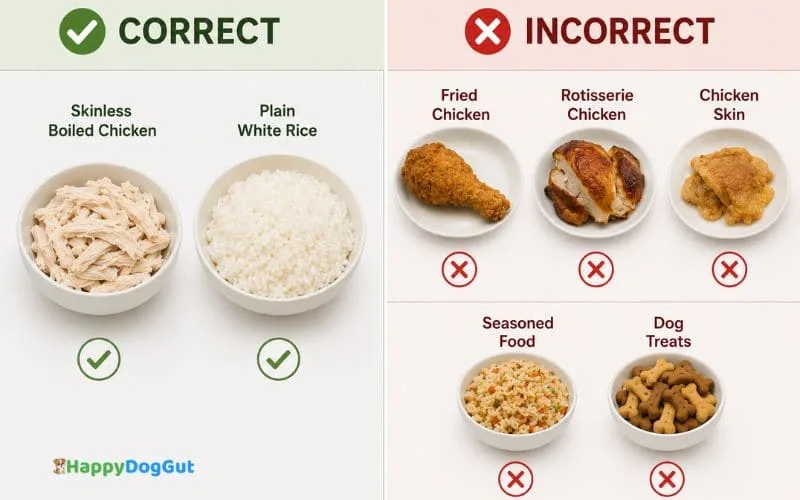
Chicken and rice is one of the most commonly recommended home diets for dogs with diarrhea—but using the right ingredients doesn’t always guarantee the right results.
Many digestive setbacks happen because of how the food is prepared or served, not because chicken and rice is a poor choice. Small mistakes can irritate your dog’s stomach, delay recovery, or even cause diarrhea to return after it seemed to be improving.
Here are the most common feeding mistakes dog owners make—and how to avoid them.
🍗 Feeding Too Much Chicken
Many owners assume that because dogs love chicken, adding extra chicken will help them recover faster.
Unfortunately, that’s not always true.
Chicken provides important protein, but too much chicken changes the balance of the bland diet. A meal that’s too high in protein and too low in rice may be harder for an irritated digestive system to handle.
For most dogs, aim for the recommended ratio of:
- ✅ 2 parts cooked white rice
- ✅ 1 part boiled, skinless chicken breast
This balance is generally easier on the stomach than serving mostly chicken.
🍚 Using Too Little Rice
Rice isn’t just a filler—it plays an important role in a bland diet.
Plain cooked white rice provides:
- Easily digestible carbohydrates
- Quick energy
- A gentle source of calories
- Support for stool formation in many dogs
Some owners only offer chicken because their dog prefers it, but reducing the amount of rice can make the meal less balanced for short-term digestive recovery.
🍽️ Serving Large Meals
A dog recovering from diarrhea may act extremely hungry, but that doesn’t mean they’re ready for a full-sized meal.
Large portions can:
- Overload the stomach
- Trigger vomiting
- Worsen diarrhea
- Slow the healing process
Instead, divide your dog’s daily food into 3–5 smaller meals. Smaller portions are usually much easier to digest and allow nutrients to be absorbed more comfortably.
🧂 Adding Salt, Butter, or Seasonings
One of the biggest mistakes is preparing your dog’s meal the same way you’d prepare dinner for your family.
A recovery diet should be completely plain.
Avoid adding:
- Salt
- Butter
- Cooking oil
- Garlic
- Onion
- Pepper
- Herbs
- Spices
- Seasoned broth
While these ingredients may improve flavor for people, they can irritate a recovering digestive system. Some ingredients, such as garlic and onions, are also toxic to dogs.
🍗 Leaving the Chicken Skin On
Chicken skin contains much more fat than lean chicken breast.
Even though your dog might love it, extra fat can stimulate the digestive tract and may lead to:
- Loose stools
- Vomiting
- Increased stomach discomfort
Always use:
- ✅ Skinless chicken breast
- ✅ Visible fat removed
- ✅ Plain boiled meat
Avoid rotisserie chicken, fried chicken, or any meat cooked with oils or seasonings.
🦴 Giving Treats Too Soon
It’s exciting to see your dog feeling better, and many owners naturally want to reward them with a favorite treat.
However, introducing treats too early is one of the most common reasons digestive symptoms return.
Many treats contain:
- Extra fat
- Multiple protein sources
- Artificial flavors
- Rich ingredients
Even healthy treats can upset a digestive system that’s still healing.
Wait until your dog has:
- Produced normal stools for several days
- Successfully transitioned back to regular food
- Fully regained their appetite
Before offering treats again.
⏳ Stopping the Bland Diet Too Early
Another common mistake is returning to regular food after just one normal stool.
While your dog may appear much better, the intestines often need a little more time to recover completely.
Instead of making a sudden switch:
- Continue the chicken and rice diet until symptoms have clearly improved.
- Gradually transition back to your dog’s normal food over several days.
- Monitor stool consistency during the transition.
Taking an extra day or two is usually much easier than dealing with another episode of diarrhea.
📋 Quick Mistakes to Avoid
Here’s a simple checklist to remember:
| ❌ Mistake | ✅ Better Approach |
|---|---|
| Feeding mostly chicken | Follow a 2:1 rice-to-chicken ratio |
| Serving one large meal | Divide food into 3–5 smaller meals |
| Adding butter or seasoning | Keep everything plain |
| Using chicken with the skin on | Choose boiled, skinless chicken breast |
| Giving treats during recovery | Wait until your dog has fully recovered |
| Switching back to regular food overnight | Transition gradually over several days |
| Guessing portion sizes | Measure meals based on your dog’s weight |
💡 Small Changes Can Make a Big Difference
Most dogs recover well with chicken and rice—but success often comes down to consistency and patience.
Preparing the food properly, feeding measured portions, avoiding unnecessary extras, and giving the digestive system enough time to heal can make recovery smoother and reduce the risk of symptoms returning.
If you’re planning to switch your dog back to their regular food, don’t miss our guide on common mistakes during dog food transition. It covers the feeding errors that frequently lead to recurring diarrhea and shows you how to make the transition as gentle as possible.
How Long Should Dogs Eat Chicken and Rice?
Chicken and rice is one of the most commonly recommended meals for dogs recovering from diarrhea, but it’s important to remember that it’s a temporary recovery diet—not a permanent feeding plan.
While boiled chicken and white rice are easy to digest, they don’t provide all the vitamins, minerals, healthy fats, and nutrients your dog needs for long-term health. Feeding this diet for too long can lead to nutritional imbalances, especially in puppies and growing dogs.
For most healthy adult dogs with mild diarrhea, chicken and rice is typically fed for 2 to 3 days, or until stools have returned to normal and your dog is ready to transition back to their regular food.
🗓️ First 24 Hours
The first day is focused on helping the digestive system settle.
During this time:
- Feed small, frequent meals
- Keep fresh water available at all times
- Avoid treats and table scraps
- Monitor stool consistency and energy level
Many dogs begin showing early signs of improvement within the first day, including:
- ✅ Better appetite
- ✅ No further vomiting
- ✅ More interest in drinking water
- ✅ Slightly firmer stools
Don’t worry if the stool isn’t completely normal yet. The intestines often need more time to recover than the stomach.
🗓️ After 48 Hours
By the second day, you should start seeing noticeable progress.
Many dogs will have:
- 🐾 Firmer stools
- 🐾 Better energy
- 🐾 Fewer bathroom trips
- 🐾 A normal appetite returning
Continue feeding chicken and rice if your dog is steadily improving.
However, if diarrhea is still severe, your dog refuses food, or new symptoms develop, don’t simply continue the bland diet indefinitely. It’s time to contact your veterinarian.
🗓️ Around 72 Hours
By the third day, most healthy dogs with mild digestive upset are ready to begin returning to their normal diet.
Good signs include:
- ✅ Well-formed stools
- ✅ Eating normally
- ✅ Drinking water well
- ✅ Normal activity level
- ✅ No vomiting
If these improvements are present, you can begin gradually replacing chicken and rice with your dog’s regular food over the next several days.
🔄 Transition Back Slowly
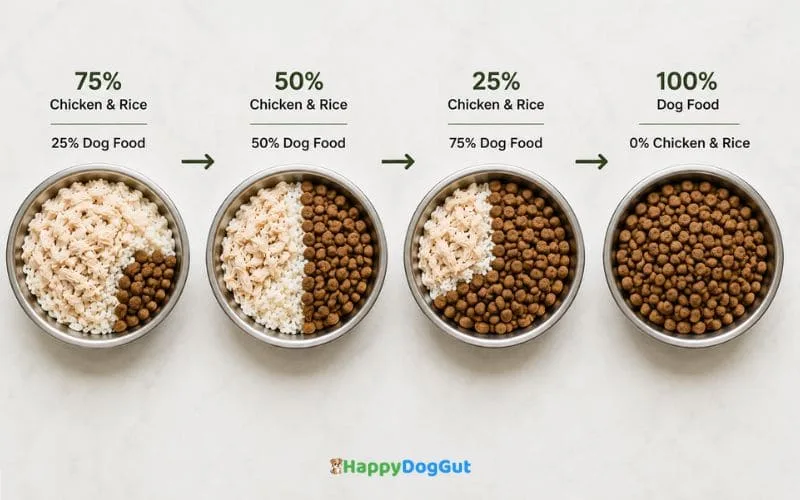
One of the biggest mistakes owners make is stopping the chicken and rice diet and immediately serving a full bowl of regular kibble.
Instead, transition gradually.
A simple schedule looks like this:
| Day | Chicken & Rice | Regular Food |
|---|---|---|
| Day 1 | 75% | 25% |
| Day 2 | 50% | 50% |
| Day 3 | 25% | 75% |
| Day 4 | 0% | 100% |
A slow transition helps reduce the risk of another digestive upset and gives the intestines time to adjust.
If you’re unsure when veterinarians recommend using this recovery diet or how long it’s appropriate to continue, read our complete guide to a bland diet for dogs.
Once your dog is ready to return to their normal diet, our article on what to feed after diarrhea walks you through the next steps and explains how to safely reintroduce regular food.
When Chicken and Rice Isn’t Enough
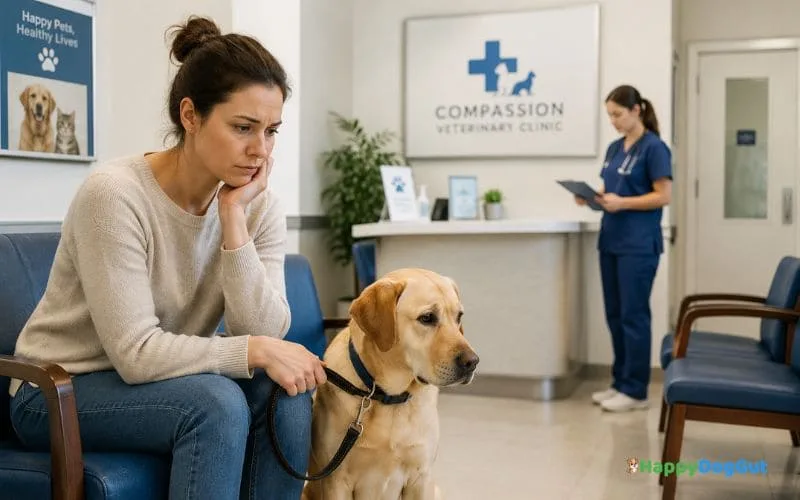
Chicken and rice works well for many dogs with mild, short-term diarrhea, but it’s not a cure for every digestive problem.
If your dog’s symptoms aren’t improving—or they’re getting worse—a homemade recovery diet won’t address the underlying cause. Continuing to feed chicken and rice while hoping things improve can delay treatment for conditions that require veterinary care.
As a general rule, your dog should be showing gradual improvement within 24 to 72 hours. If that isn’t happening, it’s time to stop relying on home care alone.
💩 Persistent Diarrhea
A few loose stools often improve with a bland diet.
However, diarrhea that continues for more than three days, keeps coming back, or becomes more severe may indicate an underlying problem such as:
- Food intolerance
- Intestinal parasites
- Bacterial or viral infection
- Inflammatory bowel disease (IBD)
- Pancreatitis
- Chronic gastrointestinal disease
If diarrhea continues despite feeding chicken and rice, your dog needs a veterinary examination rather than more days on the same diet.
🩸 Blood in the Stool
A small streak of bright red blood can sometimes occur because repeated diarrhea irritates the rectum.
However, blood should never be ignored.
Seek veterinary care if you notice:
- Bright red blood
- Bloody diarrhea
- Blood mixed throughout the stool
- Black, tarry stool
These signs may indicate bleeding within the digestive tract and require prompt medical evaluation.
🤮 Repeated Vomiting
Chicken and rice can help support dogs with mild digestive upset, but it isn’t appropriate if your dog:
- Vomits after every meal
- Can’t keep water down
- Vomits repeatedly throughout the day
- Vomits blood
Repeated vomiting rapidly increases the risk of dehydration and often signals a condition that needs veterinary treatment.
⚖️ Unexplained Weight Loss
If your dog continues losing weight despite eating, the problem is likely more serious than a temporary stomach upset.
Weight loss combined with diarrhea may suggest:
- Poor nutrient absorption
- Chronic intestinal disease
- Food allergies
- Pancreatic disease
- Other digestive disorders
A bland diet won’t correct these underlying conditions.
💧 Signs of Dehydration
Diarrhea causes significant fluid loss, especially when it’s accompanied by vomiting.
Watch for signs such as:
- Dry or sticky gums
- Sunken eyes
- Weakness
- Thick saliva
- Loss of skin elasticity
- Refusing to drink
Puppies, senior dogs, and toy breeds can become dehydrated much faster than healthy adult dogs.
If you notice these signs, don’t wait for chicken and rice to solve the problem.
🩺 Know When Home Care Ends
Home care works best when your dog is:
- ✅ Bright and alert
- ✅ Drinking water
- ✅ Eating small meals
- ✅ Improving each day
If that’s no longer true, it’s time for professional help.
If you’re unsure whether your dog’s symptoms have progressed beyond normal digestive upset, read our guide on when to worry about diarrhea.
You can also learn exactly which warning signs require veterinary attention in our article on when to see a vet for loose stool.
🐶 Key Takeaway: Chicken and rice is a supportive recovery diet, not a treatment for serious illness. If your dog has persistent diarrhea, bloody stools, repeated vomiting, dehydration, or unexplained weight loss, don’t continue home treatment—contact your veterinarian as soon as possible.
Frequently Asked Questions
Can I feed chicken and rice every day?
No. Chicken and rice is intended as a short-term recovery diet, not a complete long-term meal plan. While it’s gentle on the digestive system, it doesn’t provide all the vitamins, minerals, healthy fats, and nutrients your dog needs for everyday health.
For most healthy adult dogs, it’s best to use this diet for 48 to 72 hours unless your veterinarian recommends otherwise.
Can I feed only chicken?
It’s not recommended.
Although boiled chicken is an excellent source of lean protein, feeding only chicken creates an unbalanced diet and may even make diarrhea worse because the meal lacks enough easily digestible carbohydrates.
For temporary digestive recovery, stick with the recommended 2 parts cooked white rice to 1 part boiled chicken ratio.
Can I use brown rice instead of white rice?
White rice is usually the better option during active diarrhea.
Brown rice contains more fiber, which is healthy for many dogs under normal circumstances but may be harder to digest when the stomach and intestines are already irritated.
Once your dog has recovered, brown rice can be reintroduced if it’s already part of their regular diet.
Can I use turkey instead of chicken?
Yes.
Plain, boiled, skinless turkey breast is an excellent alternative if your dog has a chicken allergy or doesn’t tolerate chicken well.
Just make sure it’s:
Plain
Fully cooked
Skin removed
Free from seasoning, butter, oils, and gravy
Avoid processed turkey products such as deli meat or smoked turkey because they’re often high in sodium and other ingredients that aren’t suitable for dogs.
Can I add pumpkin to chicken and rice?
Yes—in moderation.
Plain canned pumpkin (100% pumpkin, not pumpkin pie filling) can be mixed into chicken and rice for some dogs. Its soluble fiber may help improve stool consistency and support digestive recovery.
Introduce pumpkin gradually and only use a small amount, as too much fiber may upset some dogs.
How many meals should I feed each day?
Most dogs recovering from diarrhea do best with 3 to 5 small meals per day.
Small, frequent meals are generally easier to digest than one or two large servings and may help reduce the chance of vomiting or worsening diarrhea.
As your dog improves, you can slowly return to their normal feeding schedule.
Can puppies eat chicken and rice?
Yes, but with extra care.
A temporary chicken and rice diet may be appropriate for puppies with mild digestive upset, but puppies become dehydrated much faster than adult dogs.
If your puppy has persistent diarrhea, repeated vomiting, refuses food, or seems unusually tired, contact your veterinarian promptly rather than relying on home treatment.
Can I freeze chicken and rice?
Yes.
Cooked chicken and rice freezes well for future use.
Store it in airtight containers or freezer-safe bags and freeze for up to 2–3 months. When needed, thaw it in the refrigerator and reheat gently until warm—not hot—before serving.
Never refreeze food that’s already been thawed.
Can I use rotisserie chicken?
No.
Rotisserie chicken is not recommended for dogs recovering from diarrhea because it often contains:
Salt
Garlic
Onion
Butter or oils
Herbs and seasonings
These ingredients can irritate the digestive system, and some—such as garlic and onion—are toxic to dogs.
Plain boiled, skinless chicken breast is always the safer choice.
How long should diarrhea last?
Many dogs with mild digestive upset begin improving within 24 to 48 hours, and their stools often return to normal within 2 to 3 days.
If diarrhea lasts longer than 72 hours, becomes more severe, or is accompanied by vomiting, bloody stool, dehydration, or unusual lethargy, your dog should be examined by a veterinarian.
Final Thoughts
Chicken and rice remains one of the most trusted short-term home diets for dogs with mild diarrhea because it’s simple, easy to digest, and gentle on an irritated stomach. However, the success of this recovery diet depends on more than just the ingredients. Feeding the right portions, using the correct chicken-to-rice ratio, and offering small, frequent meals all play an important role in helping your dog recover comfortably.
As your dog improves, continue to monitor the signs that matter most—not just whether they’re eating.
Keep an eye on:
- 💩 Stool quality – Is it becoming firmer each day?
- 💧 Hydration – Is your dog drinking enough water?
- 🍽️ Appetite – Are they eating willingly without vomiting?
- 🐾 Energy level – Are they acting more like themselves?
- 😊 Overall behavior – Do they seem comfortable and interested in normal activities?
These everyday observations often provide the best indication that your dog’s digestive system is healing.
Remember, chicken and rice is not a complete and balanced long-term diet. Once your dog has had normal stools for a day or two and is feeling well again, begin a gradual transition back to their regular dog food rather than making a sudden switch.
Finally, trust your instincts as a pet owner. If your dog’s diarrhea persists for more than a few days, worsens instead of improving, or is accompanied by repeated vomiting, bloody stool, dehydration, severe lethargy, or weight loss, don’t continue treating the problem at home. Prompt veterinary care is always the safest choice when symptoms are severe or recovery isn’t going as expected.
🐕 The goal isn’t just to stop diarrhea—it’s to help your dog recover safely. With the right portions, patience, careful monitoring, and timely veterinary care when needed, most dogs with mild digestive upset can get back to feeling like themselves in just a few days.

Hi, I’m Maddy, the writer behind HappyDogGut.com.I’m passionate about helping dog parents better understand gut health, sensitive stomachs, and nutrition through clear, practical, and research-based content. Every article is carefully researched using trusted veterinary and pet health resources, so you can make more informed decisions for your dog’s digestive health.Happy Gut = Happy Dog! 🐾
All content on Happy Dog Gut follows our Editorial Policy.

Pingback: Dog Still Has Loose Stool After Chicken and Rice: What to Do Next